
albert huie
(1934-2020)

Albert Huie: Father of Jamaican Painting
by Kevarney K.R.
Albert Huie, born in Falmouth, on December 31, 1920, during British colonial rule, was a pioneering figure in Jamaica’s visual arts culture. His practice helped define what David Boxer termed the “traditional” school of Jamaican art. In 1936, at 16, Huie moved to Kingston as anti-colonial nationalist sentiments galvanized across the British-occupied Caribbean. Two years later, these tensions culminated in the 1938 labour revolts, igniting riots locally and regionally. These political and cultural currents undoubtedly informed Huie’s early vision of identity, ultimately influencing his later works.
Although self-taught at first, Huie trained with the Armenian painter Koren der Harootian in the late 1930s, and in 1937 H. Delves Molesworth, then Secretary of the Institute of Jamaica, arranged for him to study under the English painter Bartlett. Molesworth introduced Huie to Edna and Norman Manley, who commissioned his first landscape painting of their Drumblair property. Huie continued his studies abroad, first at Ontario College of Art and the University College of Toronto, and later in London at Leicester College of Art.
Huie returned to Jamaica in 1948, 3 years after WWII and 4 years after Universal Adult Suffrage was passed. By then, Jamaica’s nationalist vision had matured, and Huie was initially unsettled by these changes. That year he and Edna Manley founded the Jamaica School of Arts and Crafts, precursor to the Jamaica School of Art, later the Edna Manley College. Huie also taught at Clarendon College, Wolmer’s Boys’ School, and Excelsior High. As Edward Lucie-Smith notes, Huie grew disillusioned with the social implications of Michael Manley’s first administration in the 1970s, prompting his move to Toronto and later Baltimore, where he died in 2010.
Although often remembered as a landscape painter, Huie’s career was far more expansive. According to Boxer, his early work focused on portraiture and scenes of everyday Jamaican life, over time growing to encompass figure compositions, baptismal ceremonies, crop harvesting, construction work, market scenes, river washing, and other images that vividly capture the rhythms of Jamaica.
 The BaptismArchival print. Signed by artist. 7 w x 10h inches |
|---|
 The ReapersArchival print. Signed by artist. 13 w x 15 h inches |
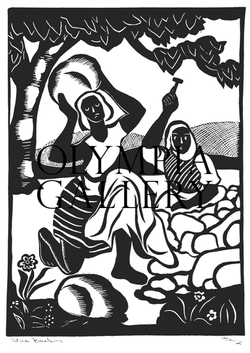 Stone BreakersArchival print. Signed by artist. 7 w x 10 h inches |
 Road MendingArchival print. Signed by artist. 7 w x 10 h inches |
 SorrelArchival print. Signed by artist. 7 w x 10 h inches |